Security Operation is like a product and this product need a product designer and a product owner. UTIOM assumes clear ownership of the security operations lifecycle, similar to product ownership in engineering organizations.
1.1 Management and Leadership Principles#
“Vision Defines Systems”
Every durable organization begins with a clearly articulated purpose. Let’s borrow from Peter Drucker9’s principle, “Without a purpose, there is no management,” captures the essence of governance. In security operations, vision establishes why the SOC exists, what it protects, and how success is measured. Without it, detection efforts drift toward tool management rather than risk management.
TOGAF Standard, 10th Edition10’s Architecture Vision and ISO/IEC 27001:2022/Amd 1:2024 Clauses 5.1–5.3 both mandate top-management direction. UTIOM extends this requirement by treating Vision as the first operational control in the lifecycle. A well-stated vision defines the business value of security, aligns stakeholders, and sets the boundaries for engineering design.
“Strategy as the Bridge”
Henry Mintzberg11 described strategy as “a pattern in a stream of decisions.” UTIOM interprets this to mean that strategy must continually translate high-level objectives into actionable, prioritized outcomes. Where traditional strategies become shelf documents, the UTIOM Strategy domain behaves like a living architecture: capabilities are built, tested, and refined against evolving risk and threat contexts. The bridge between vision and execution remains active.
“Continuous Improvement and Kaizen12”
Borrowed from the Toyota Production System, Kaizen emphasizes that small, consistent improvements lead to compound transformation. Deming’s PDCA cycle provides the mechanics Plan, Do, Check, Act. In UTIOM, Continuous Improvement is not a trailing activity but an integral feedback phase that restarts the entire lifecycle. Each iteration strengthens strategic clarity, detection precision, and operational confidence.
“Improvement is not a phase; it’s a culture.”
“ Management and leadership role is crucial, therefore we need to select the right methodology”
"Management by Objectives for Defence" Borrowing from Drucker’s MBO13, UTIOM ensures that detection engineers and analysts are not just 'running tools', but are partners in creating value. By setting SMART14 goals aligned with Crown Jewels protection, the system maintains a 'Spirit of Performance' where every technical action is a traceable step toward a strategic outcome.
Drucker popularized MBO to ensure that everyone in an organization is aligned on shared goals. In a SOC, this prevents "random operation" by ensuring technical tasks serve a strategic purpose.
Collaborative Goal Setting: Objectives are set through discussion between managers and the technical "knowledge workers" (analysts and engineers), ensuring they understand how their work contributes to the larger vision.
Cascade of Objectives: High-level strategic goals are translated into day-to-day tasks, such as improving Mean Time to Contain (MTTC) for "Crown Jewel" assets.
SMART Criteria: Objectives must be Specific, Measurable, Achievable, Realistic, and Time-bound.
“The "Knowledge Worker" as Assets”
Drucker coined the term "knowledge worker" for employees whose primary asset is their theoretical and analytical knowledge.
Empowerment and Autonomy: Because SOC analysts often know more about specific threats than their managers, they require autonomy to solve unique problems.
Continuous Learning: Knowledge is "perishable"; it must be constantly improved and challenged, or it vanishes.
Focus on Strengths: Effective management makes an employee's strengths productive and their weaknesses irrelevant.
"Systematic Abandonment" As Drucker noted, 'If you want something new, you have to stop doing something old'. UTIOM integrates this by treating the pruning of obsolete telemetry and detections as a core engineering discipline, preventing the SOC from becoming a 'factory of data'.
“Be aware of ‘Effectiveness vs. Efficiency’”
A core Drucker principle is distinguishing between "doing things right" (efficiency) and "doing the right things" (effectiveness).
Prioritizing Impact: There is nothing so useless as doing efficiently that which should not be done at all. In UTIOM terms, efficiently detecting "random noise" is a failure of management if it doesn't control actual business risk.
Measuring Outcomes: Focus on metrics that prove effectiveness (e.g., Risk Reduction) rather than just efficiency (e.g., Number of Alerts).
In fact we should think this way:
"Vision as the Primary Control": Following Drucker’s principle that "Purpose is the starting point of management," UTIOM treats the Vision not as a statement, but as the first operational control that dictates the boundaries of all engineering efforts.
"The Knowledge Worker's Autonomy": In a UTIOM-led SOC, analysts are "Knowledge Workers" whose primary task is to interpret intent, not just operate or manage tools. Management’s role is to provide the "Strategy Bridge" so these workers can exercise "Self-Control" through observability. Management should lead all roles to be aware of the operation model in Security Operation and everyone must be aligned and aware of priorities. (The goal is to be Threat-Informed and it wont achieve until everyone would be on the same page.)
"Systematic Abandonment": To prevent the "factory of data" from becoming bloated, UTIOM adopts Drucker's rule of "abandoning yesterday." Every Continuous Improvement cycle (Section 2.7) must include a review to "slough off" detection rules that no longer protect a Crown Jewel or address a current threat.
"Effectiveness over Efficiency": Drucker noted that "Efficiency is doing things right; Effectiveness is doing the right things." UTIOM ensures effectiveness by forcing detection rules to be mapped to a specific risk requirement rather than just high-volume research.
1.2 Engineering and Systems Thinking#
SOCs often resemble factories of data rather than engineered systems. They assemble technologies like SIEM, EDR, SOAR without a unifying design logic. UTIOM applies systems engineering to security operations: define inputs, outputs, boundaries, and feedback before integrating components.
“Systems Are Engineered, Not Assembled”
From NASA’s engineering philosophy: reliability results from design, not accumulation. UTIOM adopts this by mapping every operational process to its dependencies and feedback signals. For example, telemetry inputs (visibility) produce detection artifacts (outputs) that trigger response mechanisms; response data then feeds the next design cycle.
“DevOps Logic15 for Detection”16
Modern engineering thrives on iteration and testing. UTIOM’s detection engineering domain mirrors software practices:
Test-Driven Detection rules must be verifiable against simulated threats.
CI/CD Pipelines deploy, validate, roll back safely.
Version Control trace every rule’s lineage and purpose.
Observability measure false-positive rates, detection coverage, and rule latency.
By codifying detection as engineering code, UTIOM transforms threat detection from reactive art to accountable science.17
“Detection becomes engineering, not improvisation.”
“UTIOM standardizes the lifecycle and engineering discipline, not the threats or detections themselves.”
Note:
Beyond just using Git and CI/CD, apply actual software architecture patterns to how you write detections.
DRY Principle18 (Don't Repeat Yourself): move repeated logic and exclusions to shared configuration objects. For example, instead of writing the same IP exclusion list into 50 different SIEM rules, move that list into a global "Configuration Object."
Abstraction Layers: Create a "Common Information Model", so logic survives vendor changes. Your detection logic should not care if the data comes from CrowdStrike, SentinelOne, or Sysmon. The logic should sit on top of a standardized schema.
Unit vs. Integration Testing: unit tests, integration tests, and effectiveness tests
Unit Testing: Testing a single detection rule against a small JSON log snippet.
Integration Testing: Testing how that rule interacts with the alerting pipeline and the SOAR playbook.
Effectiveness Testing: Testing if the rule would trigger in expected situation.
Borrowed from Industrial Design: Cognitive Ergonomics and "Affordance"
In industrial design, a well-designed tool "tells" you how to use it and it is purpose driven. So a Security Operation should be designed in the same way. Security operations must be designed for human cognition:
Signal-to-Noise Ratio (SNR) Optimization: Industrial designers remove clutter to focus the user on the primary control. Optimize signal-to-noise ratio through grouping and narrative incidents.
Standardized Interfaces: Ensure that regardless of the tool, the "Output" (the alert) always follows the same visual hierarchy: What happened? Why does it matter? What is the first step to fix it? And so on. We need the whole story, the big picture, the time-line, not random single alerts.
Reducing "Alert Fatigue" as a Design Goal: Treat alert fatigue and analyst burnout not as a HR issue, as a system design failure.
“Resilience and Graceful Degradation”
Assume components fail. Security operations must remain functional when sensors are bypassed or degraded:
Redundant visibility paths (e.g. identity and network telemetry as backup to endpoint)
Backpressure and circuit breakers for log spikes
Meta-detections that monitor the health of telemetry and detection pipelines
“Less, But Better: The Minimalism of Defense” Following Dieter Rams19’ principle that 'Good design is as little design as possible,' UTIOM rejects the accumulation of tools, logs and running different separate teams and process. Instead, it focuses on the 'Honesty' of detection—ensuring that every alert accurately reflects a business risk and provides an 'Understandable' path to response. By prioritizing 'Unobtrusive' systems that only signal when necessary, we eliminate the noise of the 'data factory' and protect the analyst's cognitive ergonomics. We should design a unified system that works purposefully.
“Feedback Loops as Learning Systems”
Every SOC event true positive, false positive, near-miss becomes structured feedback. Data from detection and response flows back into telemetry design and strategic planning. This creates a self-correcting ecosystem capable of continuous adaptation without external audits.
“Design, don’t assemble. Detection should be built with purpose, not patched with panic.”
“Systems Engineering: Requirements Traceability (The V-Model)20”21
Systems engineering dictates that a system’s success is measured by how well it meets specific requirements. In many SOCs, detections are added randomly based on "cool" research rather than system needs.
Requirements Mapping: Every detection artifact should be traced back to a specific risk or threat model (e.g., MITRE ATT&CK). If a detection doesn't map to a requirement, it is usually "waste" in the system.
Verification vs. Validation:
Verification: Does the rule work as intended? (e.g., Does the regex match the log?)
Validation: Does the rule actually stop the business risk? (e.g., Does it catch the actual attacker? Or it is just a random prebuilt rule with no risk assigned?)
1.3 The Convergence#
Leadership provides direction and intent; engineering provides precision and reliable execution. When disconnected, organizations experience strategic confusion above and operational fatigue below. That is a common point of failure.
UTIOM unifies them through a recursive lifecycle that binds strategy, engineering, and intelligence.
So before we see the schematic concept in a high level diagram, let’s recap the idea of UTIOM:
We typically have 3 main pillar for running a Security Operation:
Leadership & Governance
Engineering & Enablement
Operations & Analysis
And each one of them having their own subprocess. In zoom-out we will have the Unified Threat Informed Operation Model. UTIOM provides the unified loop that keeps these pillars aligned through continuous feedback.
For implementing UTIOM we do need to define our Security Operation Vision, with a defined Vision we can now define our Security Operation Strategy, and with a Risk-Based approach we can review our assets and define our Crown-jewels, this can lead to check our visibility of our critical assets and continuous development of threat detection rules for them, having detection rules can led to developing proper response plan/playbooks.
The Unified Loop:
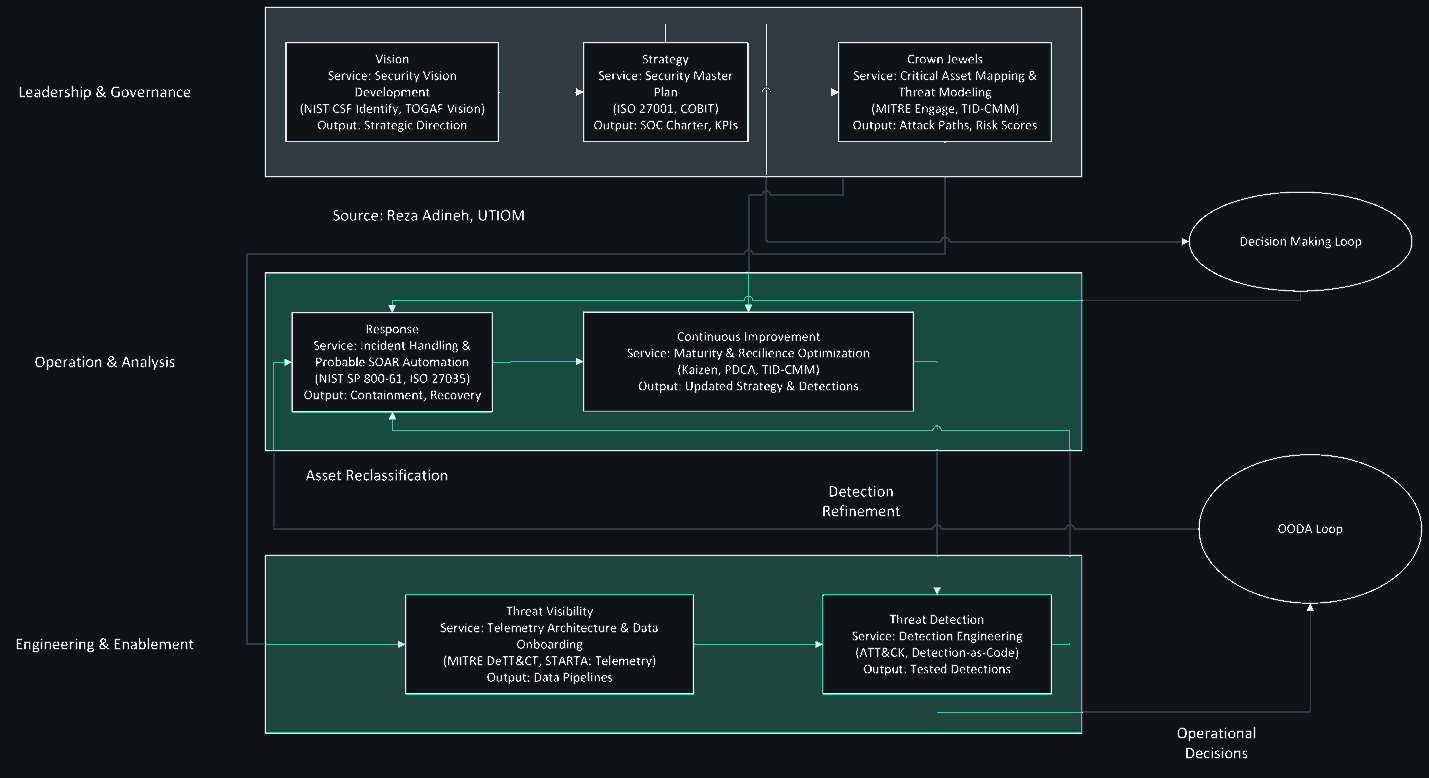
Figure 1- UTIOM high level
Each phase consumes and produces knowledge. Outputs of one become inputs to the next. This cyclical logic converts fragmented operations into an adaptive control system.
Why Unification Matters?
Strategic Traceability: executives can trace any incident to a policy, metric, or capability.
Engineering Efficiency: teams build only what serves defined business and threat priorities.
Cultural Alignment: analysts understand purpose; leaders understand constraints.
The convergence yields a system that learns both top-down and bottom-up a Threat-Informed Organization rather than a reactive monitoring centre.
“A SOC without a vision is an alert factory.”
1.4 UTIOM Concept review#
A well-defined vision and strategy function like a north star. In Security Operation without defining vision and strategy and knowing the crown jewels it is not possible to accomplish anything successful.
In this section we will see how this UTIOM framework will help you to unified a meaningful threat informed detection and response in a practical way.
Starting with vision, a practical way of defining vision would be defining a meaningful goal, like we are aware of all critical Risk that target our Crown Jewels.
From strategic point of view we need to define at least some basic strategies but practical, doing a threat profiling for our business is one mandatory thing and is the main basic step, that should define the baseline for threat detection approaches. While we knew about our adversaries, their intent, motivation and their probable capabilities, now we can be ready for defend, and align our detection and response program accordingly.
So in summary, UTIOM’s practical sequence:
Define vision for Security Operation, (Vision is why or the target destination, is the goal of the SecOps)
Define, develop and implement strategy for Security Operation, The main basic activity is about Implementing Threat Profiling and Risk prioritization. (Vision define strategy, Strategy is how to achieve to the defined Vision, it is the practical, logical actionable roadmap to use the vison and implement our Design.)
Identifying business key assets & crown jewels, Providing Threat Visibility, (Threat Detection should be an ongoing continues process, and it is fed by Threat modelling and threat intelligence mainly) and model realistic threats against them.
Developing aligned Threat Modelling,
Checking the visibility status by being sure we generate and collect main necessary telemetry,
Considering implementation of deception solutions (In a more mature situation placement of deception solution for a proactive detection and analysis),
Engineer visibility, ensure telemetry exists where it matters most
Engineer detection as a lifecycle (code, testing, fidelity, coverage)
Engineer response via playbooks and automation aligned to threats and crown jewels
Continuously improve using lessons learned and validation loops (purple team)22
Important note:
Mapping UTIOM to NIST Incident Response
This framework is exactly aligned with Incident Response steps and is a way to modernize, extend and implement the Incident Response for Security Operation in a Threat Informed Way and Risk aware approaches.
In NIST SP 800-61 Rev. 3 (Incident Response Recommendations and Considerations for Cybersecurity Risk Management: A CSF 2.0 Community Profile, April 2025). The four-phase model below is the legacy SP 800-61 Rev. 2 lifecycle, retained for practitioner familiarity; Rev. 3 integrates incident response across CSF 2.0. The four-phase lifecycle shown below is the legacy SP 800-61 Rev. 2 model, retained here for practitioner familiarity and historical comparison:
Preparation
Detection & Analysis
Containment, Eradication & Recovery
Post Incident Activity
So to map it with UTIOM it is as below:23
| NIST Incident Response Functions | Unified Threat Informed Operation Model (UTIOM) Functions |
|---|---|
| Preparation | Vision, Strategy, CJ, Threat Profiling, Threat modelling, Threat Visibility |
| Detection & Analysis | Threat Detection Engineering (rules, tuning, analysis workflows) |
| Containment, Eradication & Recovery | Response (playbooks, containment automation, recovery coordination) |
| Post Incident Activity | Continuous Improvement(learning loop, updates to strategy and engineering) |
In the next section we will explain the Unified Lifecycle that UTIOM farmwork provide for an effective modern and unified way of implementing Incident Response for a Security Operations.
Notes
- Peter Ferdinand Drucker (1909–2005) was an Austrian-American author, educator, and management consultant widely regarded as the "Father of Modern Management". He transformed management into a distinct, teachable discipline that balances technical efficiency with social responsibility. ↩
- The Open Group Architecture Framework. It is a widely used, open standard methodology and framework for designing, planning, implementing, and governing an enterprise's information technology architecture to align with business goals. ↩
- Henry Mintzberg is a prominent Canadian academic, author, and Professor of Management Studies at McGill University, known for his influential work in business and management that often challenges conventional wisdom. He has written over 150 articles and more than 20 books on topics including strategy, organizational design, and leadership education. ↩
- Kaizen (改善) is a Japanese term and business philosophy that means "continuous improvement". The word is composed of two characters: "kai" (meaning change) and "zen" (meaning good). The philosophy centers on the idea that many small, incremental changes made consistently over time can lead to significant positive results in efficiency, quality, and productivity. ↩
- Management by Objectives ↩
- Specific, Measurable, Achievable, Realistic, and Time-bound ↩
- Detection Engineering Life Cycle" (DELC) ↩
- Do not rely on default detection rules in place, tailor them to your environment. (Even if the default rule looks good for you, you still need to keep them updated regularly.) ↩
- In case you are not ready to implement the codified system for detection development, do not skip this, it is more about the concept and idea of how to develop a detection code in a managed controlled way like we do release a stable software. For start consider any methodology to develop a code and having a version control for it, and being able to trace a detection for the whole lifecycle of it. ↩
- The DRY principle is a fundamental software development guideline introduced by Andy Hunt and Dave Thomas in their 1999 book The Pragmatic Programmer. The core idea is that every piece of knowledge, logic, or data within a system should have a single, unambiguous, and authoritative representation. ↩
- Dieter Rams is a highly influential German industrial designer. He is best known for his long tenure as the head of design for the consumer electronics company Braun from 1961 to 1995, and for his work with the furniture company Vitsœ. His design philosophy, encapsulated by the phrase "less, but better" (Weniger, aber besser), has had a lasting impact on 20th-century aesthetics and modern design practices, notably influencing designers at Apple, such as Jony Ive. ↩
- V-Model, a structured approach used primarily in software development and systems engineering. The V-Model is a procedural model that visually demonstrates the relationship between each stage of the development life cycle and its corresponding testing phase, which creates the "V" shape. ↩
- The V-Model is a procedural model that visually demonstrates the relationship between each stage of the development life cycle and its corresponding testing phase, which creates the "V" shape.Left Side (Verification/Development Phases): The process moves downward from high-level, abstract requirements to detailed design specifications. This phase ensures you are "building the product right" according to the plan.Right Side (Validation/Testing Phases): The process moves upward, involving testing activities that correspond directly to a development phase on the left. This phase ensures you are "building the right product" that meets the user's actual needs.The Bottom of the V: Represents the coding or implementation phase, where the actual product is built.IAPM - International Association of Project ManagersRequirements Traceability in the V-ModelRequirements traceability is the ability to track the life of a requirement from its origin through development and testing back to its source or vice versa.Purpose: It ensures that every single requirement defined at the beginning of the project is accounted for, implemented, and thoroughly tested.Mechanism: Traceability links connect requirements documents (left side) to their relevant test cases (right side). For example, the initial user requirements are linked to the User Acceptance Tests (UAT).Benefit: This clear, bidirectional link makes it easier to track progress, manage changes, ensure quality and compliance (especially in safety-critical industries like automotive or medical devices), and prevent overlooked requirements. ↩
- With having the threat profiling, knowing targeted high risk threats, having threat modelling and related threat detection rules, leveraging threat intelligence, we can work on threat hunting with a clear strategy of what we should looking for. Furthermore, in order to improve our threat detection program we can use the OODA loop, in order to see how effective is our current detection rules. For testing the rules, using Purple teaming, Red teaming is the way to go.Knowing threat detections, we can now think of response plan and if possible business continuity plan based on realistic threats we already monitoring. It could lead to asset reclassification as well.This is the last step of our main steps, continuous improvement. With continuous improvements we will take a look to the whole cycle, and see how and where we can improve. And this could lead to refine the strategies. ↩
- UTIOM complements, not replaces, all mapped frameworks. ↩
Adineh, R. (2026). The Foundations. UTIOM Framework
  Book, edition 1.2. utiom.de/book/foundations/