This chapter opens a three-part section on what distinguishes UTIOM from conventional security operations frameworks: its management foundation, its engineering discipline, and its treatment of response as the operating mode itself.
Ask a struggling SOC what it needs, and you will hear a list of tools. A better SIEM. More automation. Another threat intelligence feed. Ask the same SOC what its purpose is, and the room goes quiet.
That silence is the problem UTIOM was built to solve. And it explains the first thing that makes UTIOM different from conventional security operations frameworks: it does not begin with technology, compliance, or even threats. It begins with management science.
Most security frameworks descend from audit. They inherit the audit worldview: controls, checklists, evidence, certification. UTIOM descends from a different lineage — Peter Drucker, Henry Mintzberg, W. Edwards Deming, John Boyd, Dieter Rams, Sun Tzu. Not one of them worked in cybersecurity. All of them solved the problem security operations actually has.
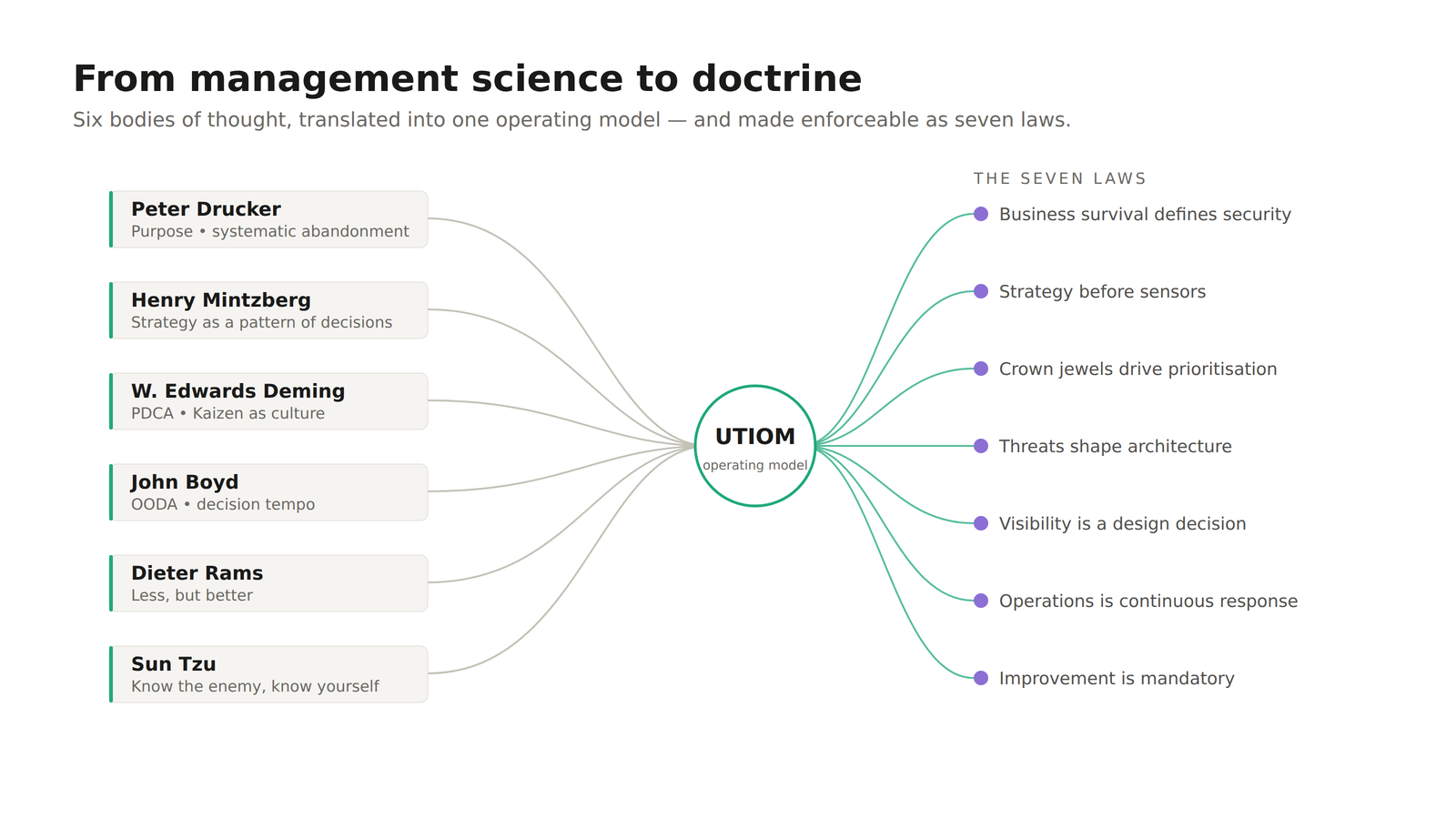
Figure — Six thinkers, none of them in security, translated into enforceable doctrine.
Because here is the uncomfortable truth this framework is built on: most SOC failures are management failures wearing technical costumes. Alert fatigue is not a staffing problem. Detection sprawl is not a content problem. Improvised response is not a skills problem. They are the predictable output of operations that were assembled instead of designed.
This chapter shows how each principle was translated — and why being loyal to them changes what a SOC becomes.
Drucker: Without a Purpose, There Is No Management#
Drucker's most quoted insight is also his most ignored in security: "Without a purpose, there is no management."
UTIOM takes this literally. Vision is not a poster or a mission statement — it is the first operational control in the lifecycle. Before a single log source is onboarded, the organization must be able to answer why the SOC exists, what it protects, and what success looks like in terms of business survival. Every downstream decision — telemetry, detection, response — inherits either that clarity or that ambiguity.
The doctrine states it bluntly: a SOC without a vision is an alert factory. The compass defines direction; tools merely execute it.
Drucker gives UTIOM three more gifts that almost no security framework has absorbed:
Systematic abandonment. "If you want something new, you must stop doing something old." In UTIOM, every improvement cycle must retire detection rules that no longer protect crown jewels. Detection libraries are treated as perishable inventory, not accumulated wealth. Rule count is not a metric of strength — sometimes it is a metric of neglect.
Knowledge workers. Analysts are autonomous specialists, not tool operators. A framework that measures them by tickets closed misunderstands what they are for.
Effectiveness over efficiency. Doing the right things beats doing things right. A SOC can be brutally efficient at triaging alerts that never mattered.
Mintzberg: Strategy Is a Pattern, Not a Document#
Henry Mintzberg defined strategy as "a pattern in a stream of decisions." Not an annual PowerPoint. Not a shelf document reviewed once a year and disconnected from execution.
UTIOM operationalizes this: your real strategy is visible in what you build, what you sequence, and what you decline — week after week. If the strategy document says "threat-informed defense" but the stream of decisions says "whatever the vendor shipped this quarter," then the vendor is your strategist.
This is why UTIOM embeds strategy as a daily operational control rather than a leadership ritual. Governance and operations belong in the same place. Strategy and execution must be traceable as two ends of the same thread.
Deming: Improvement Is Not a Phase, It's a Culture#
From Deming and the Toyota Production System, UTIOM takes the Plan-Do-Check-Act cycle and Kaizen — and refuses to treat them as ceremony.
Continuous Improvement is a full lifecycle domain in UTIOM, with the same standing as Detection or Response. Every incident ends in a Kaizen review. Every purple team exercise feeds the threat model. Every failed detection is an engineering defect with an owner and a date — not a lesson filed and forgotten.
The phrasing in this framework is deliberate: "Improvement is not a phase; it's a culture." And its consequence is measurable: small, consistent changes compound better than periodic overhauls. No design remains optimal forever, so a SOC that is not learning is decaying — quietly, and on schedule.
"Learning is the final deliverable of every incident."
Boyd: The Adversary Sets the Tempo#
John Boyd's OODA loop — observe, orient, decide, act — was born in air combat, where the pilot with the faster decision cycle imposes the terms of the fight.
UTIOM applies this without dilution. Response is measured against adversary breakout time, not against internal SLAs alone. Decision latency is tracked separately from MTTR, because the two hide different failures: a team can respond quickly and still decide slowly.
This is also where one of UTIOM's structural ideas comes from — moving decisions left. Containment authority, isolation thresholds, business impact tiers: decided at design time, in daylight, not improvised at 3 a.m. during an incident. Decisions that should be made at design time otherwise get made during incidents instead — at the exact moment leverage is lowest and cost is highest.
Rams: Less, but Better#
Dieter Rams designed radios and shelving, and his tenth principle — "Good design is as little design as possible" — may be the most subversive idea UTIOM imports.
In UTIOM, analyst attention is a scarce engineered resource. Signal-to-noise ratio is a design specification. Alert fatigue is classified as a system design failure, not an HR issue to be solved with hiring or resilience training.
This is the minimalism of defense: less, but better. Well-designed security operations are not loud. They are deliberate, predictable, and boring — and boring, in this discipline, is a compliment earned through engineering.
Sun Tzu: Know the Enemy and Know Yourself#
The oldest principle in the stack is the one most organizations fail on the second half of: "Know the enemy and know yourself."
Modern threat intelligence has made knowing the enemy almost fashionable. Knowing yourself — a real crown jewel registry, an honest maturity assessment, documented visibility gaps formally accepted rather than discovered mid-incident — remains rare. UTIOM makes both mandatory, and makes crown jewels the universal anchor: telemetry, detection, playbooks, and budget all trace back to what actually keeps the organization alive.
No organization can protect everything equally. Pretending otherwise is not ambition; it is the absence of prioritization.
Why This Foundation Matters#
Put these principles together and something changes in kind, not degree. Security operations stop being a cost center that reacts to noise and become a living, engineered system — a product with a vision, a strategy, engineered features, measurable outcomes, and continuous feedback.
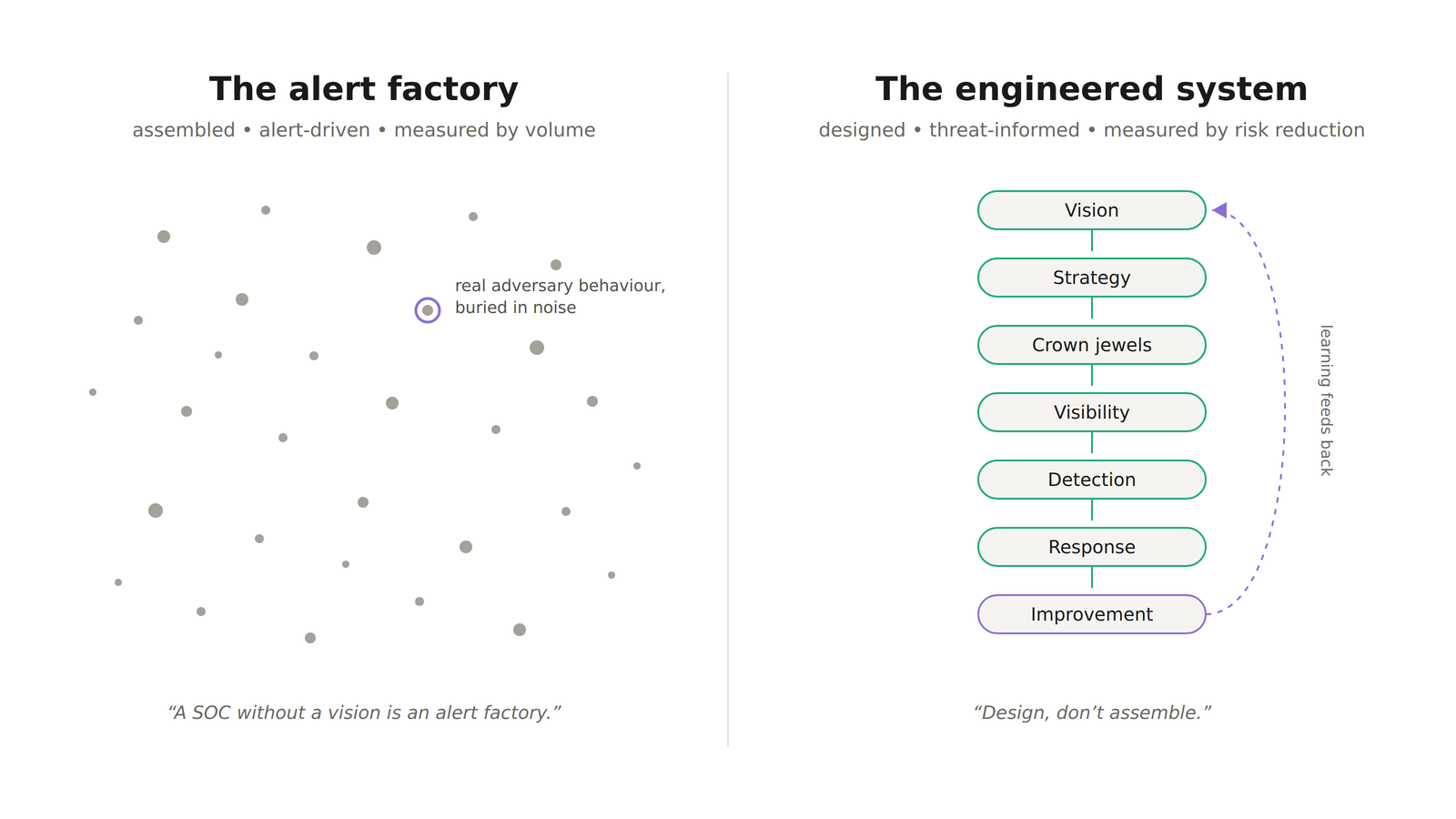
Figure — The difference vision makes: an alert factory, or a system with a purpose.
This is the root of every other difference UTIOM has. The seven laws of its doctrine — business survival defines security, strategy before sensors, crown jewels drive prioritization, and the rest — are not arbitrary rules. They are what Drucker, Mintzberg, Deming, Boyd, Rams, and Sun Tzu sound like when translated into security operations and made enforceable.
Frameworks that start from audit produce organizations that pass audits. Frameworks that start from tools produce organizations that operate tools. UTIOM starts from management — and produces organizations that can explain, in business language, why every detection exists, why every euro was spent, and why the SOC deserves to exist at all.
"Security operations will not mature by adding more tools. They mature when treated as a system, designed with intent, and improved deliberately."
That is the first difference. It is also the one that makes all the others possible. The next chapter follows this foundation into the detection layer, where management principle becomes engineering discipline.
Adineh, R. (2026). It Starts With Management, Not Tools. UTIOM Framework
  Book, edition 1.2. utiom.de/book/management-not-tools/